LACW 2026
2026 Latin American CubeSat Workshop
When
March 15-17, 2026
Where
Jurere Beach Village
Florianopolis, Santa Catarina, Brazil
The Latin American CubeSat Workshop (LACW) is the main forum in Latin America for discussing
scientific and technological advances in the CubeSat and small satellite field.
For the past years, the event has brought together researchers, students, industry professionals,
and space agencies to strengthen collaboration and foster innovation across the region.
The 2026 edition will take place in Florianopolis, Santa Catarina, Brazil,
hosted by UFSC, at the
Jurere Beach Village, a beachfront conference hotel located in one of Florianopolis' most beautiful areas. The venue provides modern conference facilities, accommodation, and a professional environment for this international gathering.
This year, LACW will be organized jointly with the
Latin American Test Symposium (IEEE LATS 2026),
creating a unique opportunity to connect the space engineering community with specialists in testing,
reliability, and component qualification.
The main theme of LACW 2026 will be
"Test and Systems Engineering".
The workshop will emphasize the challenges of verification and validation of space systems,
and how different teams across Latin America are implementing (or struggling to implement) these processes.
Discussions will address how CubeSat projects in the region are planning and executing tests, what facilities
and laboratories are accessible for environmental and functional verification, which organizations provide
certifications recognized by international launch providers, and how commercial or automotive components (COTS)
can be adapted for space applications when access to space-qualified parts is limited.
By bringing together the LACW and LATS communities, this edition will stimulate discussions on how to increase the reliability and engineering maturity of Latin American missions, bridging the gap between academic research, industry practices, and the requirements of launch providers.
The event is organized by a technical and scientific committee of researchers from different institutions across Latin America,
with the support of their organizations.
The Latin American CubeSat Workshop is a unique opportunity to strengthen the
"New Space" ecosystem in Latin America, promoting dialogue between academia, industry, and government,
and bringing developers and researchers closer to the end users of CubeSat technology.
Invited Speakers & Distinguished Guests
Luis Eduardo Vergueiro Loures da Costa
Head of the Aerospace Systems Department of ITA
Ana Ambrosio
Former INPE Senior Technologist. Satellite Simulation Expert. INPE
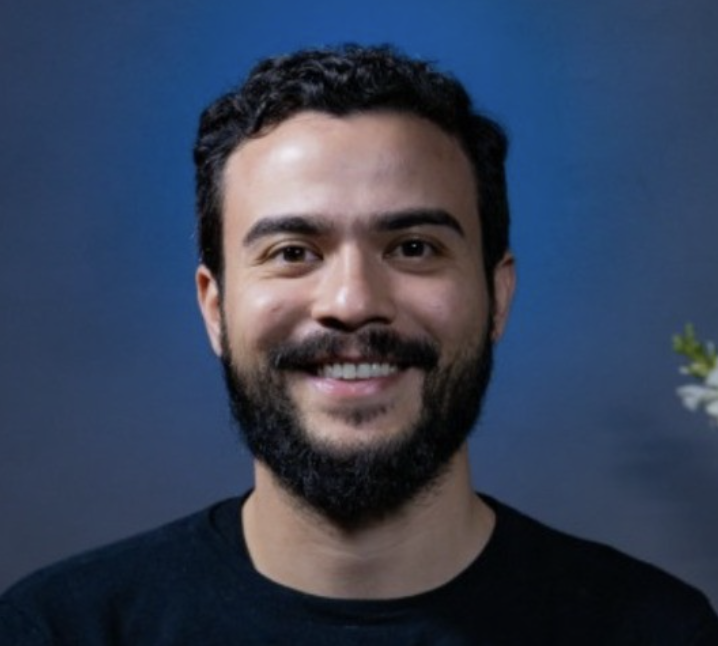
Italo Rodrigues
Satellite Systems Modeling and Simulation INPE
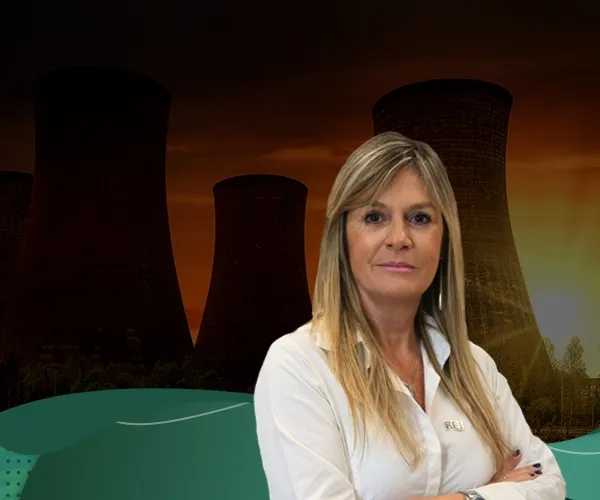
Marcilei Guazzelli
Head of the Radiation Physics and Ionizing Radiation Effects Laboratories FEI
Fabian Vargas
Senior Scientist at IHP (Germany), expert in resilient aerospace microelectronics.
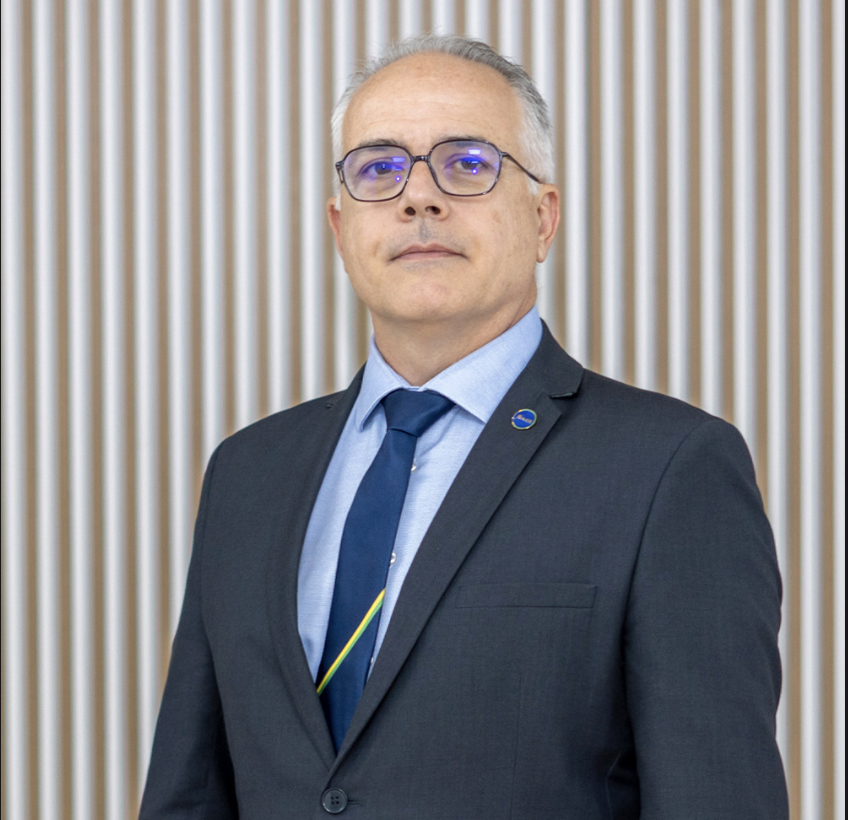
Rodrigo Leonardi
Director of Portfolio Management at AEB, leading Brazil's strategic space programs.

Nilberto H. Medina
Researcher at IF-USP working with the Pelletron Accelerator facility

Sergio Henrique Pezzin
Smart & Sustainable Materials for Aerospace UDESC
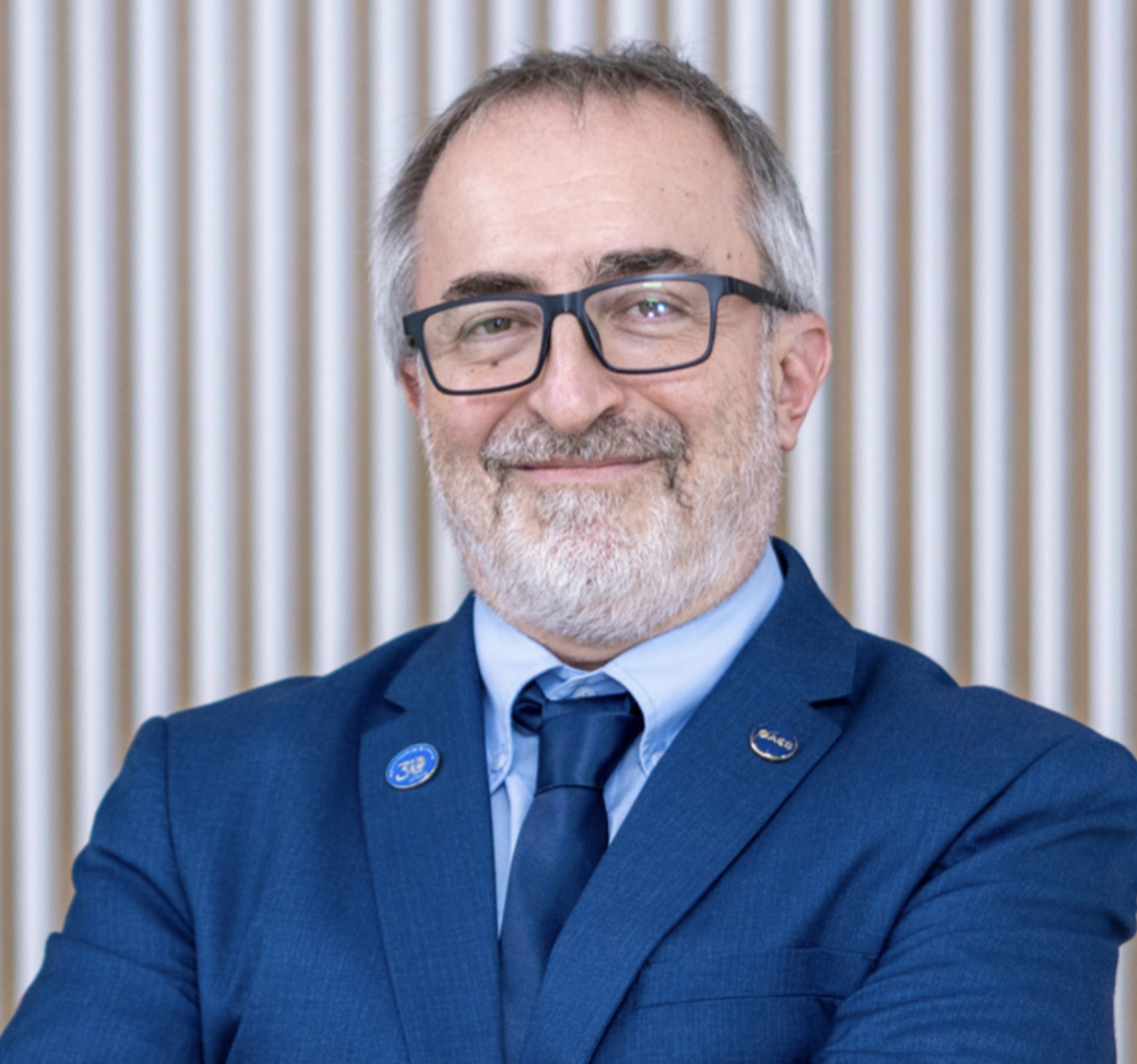
Paolo Gessini
Director of Strategic Intelligence and New Business at AEB; Space Electric Propulsion professor at UnB
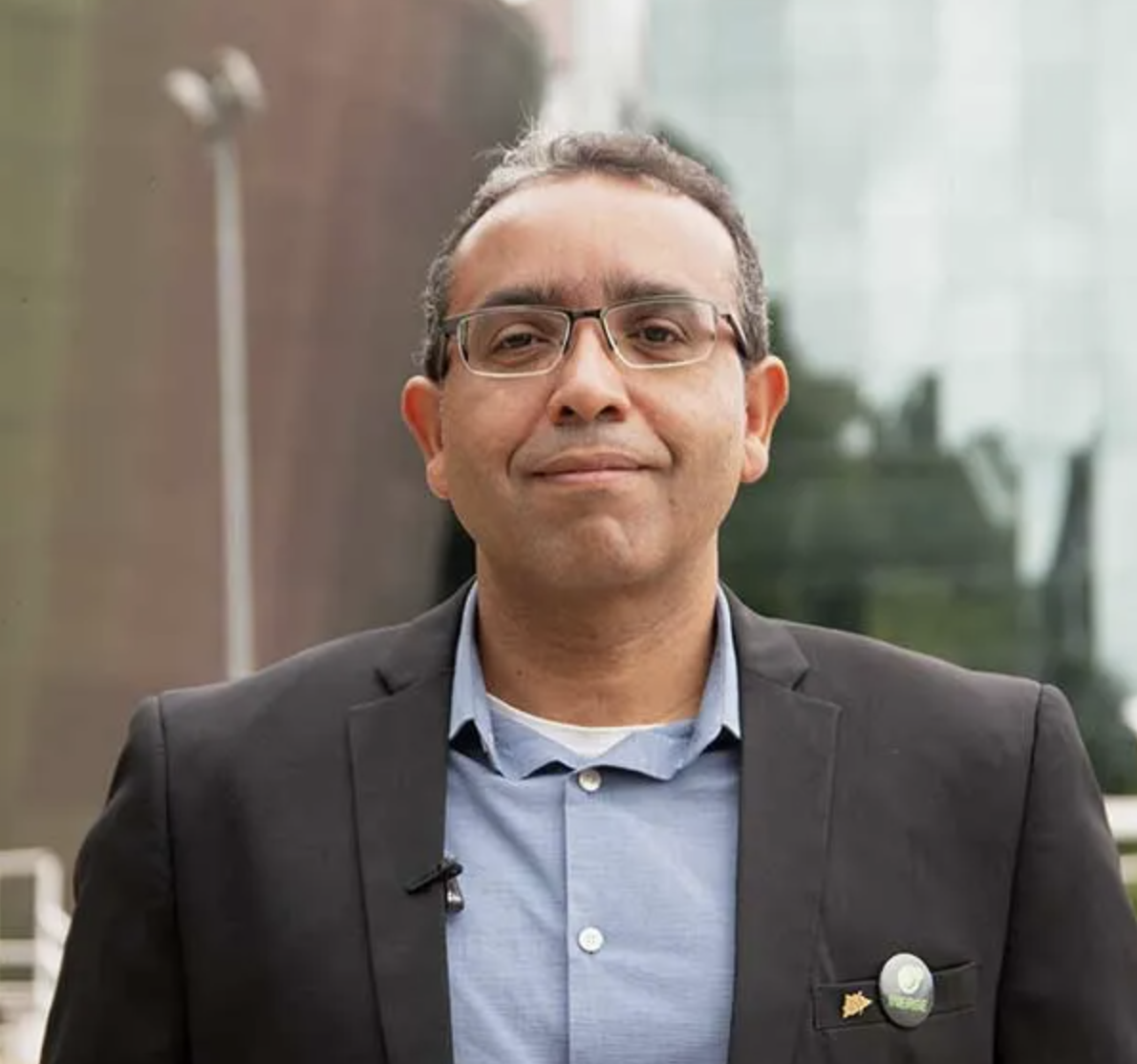
Moises Vidal Ribeiro
Signal Processing & Satellite Communications UFJF
Important Dates
Extended abstract submission
10 January 2026
Acceptance notification
31 January 2026
Full paper submission deadline
15 February 2026
Full paper review notification
28 February 2026
Camera-ready
30 March 2026
Tutorial proposal
10 January 2026
Call for Papers
The authors are invited to submit their works in Cubesat related subjects including but not limited to:
- Cubesat missions
- Cubesat constellations
- In-orbit demonstrations and flight experiences
- Embedded systems (hardware & software)
- Reliability and fault tolerance
- Assembly, Integration and Verification
- Telecommunication and ground segment
- Deep space missions
- Launch opportunities
- Attitude and Orbit Control Systems
- System engineering
- Space education
- Space regulations
Manuscripts will be reviewed by Scientific Committee members, and will be accepted according to the quality and originality of the work and/or ideas. Submissions that are based on experimental results, current data, or reports on ongoing missions are especially encouraged. During the reviewing process, the works will be selected for presentation in oral or poster sessions, according to their relevance.
It is recommended to proof read the paper before submission.
All papers must be written in English and submitted online as explained next.
- January 10, 2026 - Tutorial proposal: The tutorial proposal must be sent by email to Eduardo.Bezerra@ufsc.br (there is no template)
- January 10, 2026 - Extended abstract: The extended abstract (max 500 words) must be submitted through the following form:
- January 31, 2026 - Acceptance notification: The members of the Scientific Committee will review the submitted abstracts, and will recommend their acceptance or not. In case of acceptance, the authors will be invited to submit the full paper version.
👉 SECOND STEP - FULL PAPER SUBMISSION (AFTER THE "ABSTRACT ACCEPTANCE")
- February 15, 2026 - Full paper (see Template next)
- Submission system: http://150.162.11.196/openconf/openconf.php
- Submission Instructions (using the above OpenConf platform):
- Log in using your Submission ID and Password (sent by email through OpenConf).
- Click on "Upload File" and submit your full paper in one of the allowed formats.
- The submitted full paper will undergo a final review by the Scientific Committee to verify:
- whether the reviewers' comments (for the Abstracts) have been properly addressed; and
- whether the manuscript meets the quality standards required for publication in the proceedings.
- February 28, 2026 - Full paper review notification:
👉 THIRD STEP - CAMERA-READY (AFTER THE "FULL PAPER REVIEW NOTIFICATION")
- April 17, 2026 - Camera-ready (see Templates next)
Please upload your final paper through the OpenConf system at the following link:
http://150.162.11.196/openconf/author/upload.php
To access the system, please use your previously provided "Submission ID" and "Password".
Please note the following important guidelines:
- Only full papers corresponding to oral presentations are eligible for the review process and publication in the LACW 2026 proceedings.
- At this stage, it is sufficient to submit the paper in PDF format only.
- After the review process, authors of accepted papers will be requested to provide the source files (LaTeX or Word) for final publication.
- All submitted papers will undergo a review process, and reviewers may reject papers that do not meet the required quality standards for publication and DOI assignment.
We kindly ask you to complete the upload within the new deadline to ensure proper consideration for publication.
If you encounter any issues during the submission process, please do not hesitate to contact us.
Template for preparing the full paper:
The full paper must be between 8 to 10 pages.
- Microsoft Word: A4 (docx, 30 KB)
- LaTeX Template: (ZIP, 1.2 MB)
- Poster: Poster boards will accommodate A0 size portrait posters, i.e., height 1189 mm (46.8 inches), width 841 mm (33.1 inches).
Please note that the presenting author of each accepted paper has to register to the event.
Presentation guidelines
The conference's working language is English.
- Each presenter will have up to 15 minutes to present their work, and to answer questions from the audience. It means around 10 to 12 minutes for presenting the work, and the remaining couple of minutes for discussion with the audience.
- Presentation of all papers must be in English.
- Projector, microphone and computer will be available in the room.
- Please bring your presentation on USB flash drive, as we cannot guarantee software compatibility, you are kindly requested to bring your presentation in your desired format but also please in PDF format.
- Files can be uploaded to the local computer in the lecture room during the breaks between the sessions.
Awards
The LACW holds an awards ceremony at every conference to recognize the top three professional papers and the top three student papers. The best paper in each category receives a trophy and a special gift in appreciation of their contribution to the CubeSat research community.
Word to Overleaf Converter
Converting a Word (.docx) file to Overleaf
You can convert a Word document into LaTeX using Pandoc or an online converter.
Option A - Use an Online Tool (Easiest)
- Go to https://www.docx2latex.com or https://pandoc.online
- Upload your .docx
- Download the generated .zip or .tex file
- Import the file into Overleaf
This usually works well for:
- Text
- Titles
- Basic formatting
But tables/figures may need cleanup.
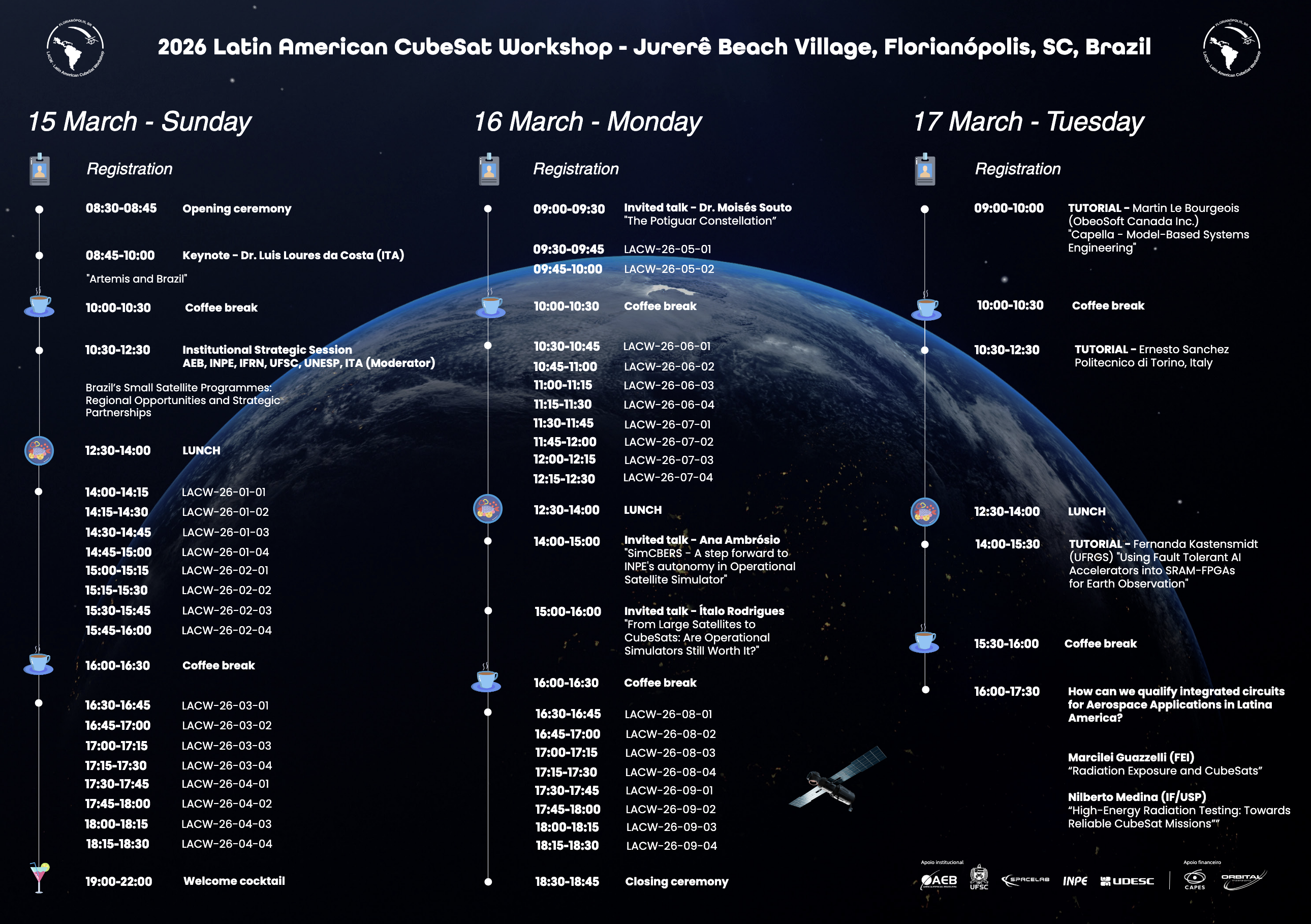
Schedule
Please click on the image below for the Preliminary Program:
Publication
All LACW papers are published in the UFSC Institutional Repository and assigned a DOI, allowing formal citation in journals, conferences, reports, and theses.
Registration
To register at LACW 2026 the first step is to fill out the registration FORM.
The registration will be processed after the registration fee payment confirmation.
The registration fee can be paid by debit or credit card. For Brazilians participants, payment via PIX is also available (click here for further instructions).
For credit card payment please use the link corresponding to the appropriate registration category, indicated below. Note that there are two payment options using the links: (1) Credit card ("cartao de credito") or (2) Debit card ("cartao de debito"). However, if you are not from Brazil, please use the option (1).
Debit or Credit Card Payment
| Category | Early Bird (register by Feb. 10) |
Payment Link | Regular Registration (from Feb. 11) |
Payment Link |
|---|---|---|---|---|
| Student | BRL 120.00 | Expired | BRL 170.00 | Payment Link |
| Professional |
BRL 500.00 | Expired | BRL 600.00 | Payment Link |
Organizing Committee
General Chair
Eduardo Augusto Bezerra, UFSC, Brazil
Acting Chairs (On-site)
Talita Sauter Possamai, UFSC, Brazil
Xisto Lucas Travassos Junior, UFSC, Brazil
Program chair
Eduardo Augusto Bezerra, UFSC, Brazil
Tutorial chair
Jeferson Berkenbrock, UFSC, Brazil
Space education chair
Paolo Gessini, UnB/AEB, Brazil
Radiation Effects chair
Marcilei Guazzelli, FEI, Brazil
Test & Simulation co-chairs
Fatima Mattiello, INPE, Brazil
Ana Ambrosio, Omega7, Brazil
Diversity initiatives chair
Maria Cecilia Pereira de Faria, UFMG, Brazil
Industrial Liason
Marcelo Essado, EMSISTI, Brazil
Otavio Durao, CRON, Brazil
Dherik Franca, UFMA/ASB, Brazil
Eugenio Preza, EP.Space BR/ASB, Brazil
Local arrangements
Fernanda Paiva de Morais, UFSC, Brazil
Rafael Venuto, UFSC, Brazil
Audiovisual Production
Arthur Farias de Souza Filho, UFSC, Brazil
Scientific Committee (past edition, 2024. 2026 - TBD )
Anderson Wedderhoff Spengler, UFSC, Brazil
Andre Pierre Mattei, SENAI-PE (ISI-TICs), Brazil
Antonio Carlos de Oliveira Pereira Junior, INPE, Brazil
Antonio Fernando Bertachini, INPE, Brazil
Carlos Alberto Rios Brito Jr., UFMA, Brazil
Cesar Augusto Missio Marcon, PUCRS, Brazil
Cezar Rigo, Embraer, Brazil
Edemar Morsch Filho, UNESP, Brazil
Ediz Cetin, Macquarie University, Australia
Eduardo Escobar Burger, UFSM, Brazil
Fabian Vargas, IHP, Germany
Fabio Armelin, INPE, Brazil
Fabricio Kucinskis, INPE, Brazil
Felipe Viel, Univali, Brazil
Geilson Loureiro, INPE, Brazil
Geraldo Magela Couto Oliveira, CEFET-MG, Brazil
Gabriel Mariano Marcelino, UFSC, Brazil
Italo Pinto Rodrigues, UniFOA, Brazil
Jarbas Aryel Nunes da Silveira, UFC, Brazil
Joao Baptista dos Santos Martins, UFSM, Brazil
Joao Claudio Elsen Barcellos, UFSC, Brazil
Laio Oriel Seman, UFSC, Brazil
Lucas da Rosa Kieslich, UFSC, Brazil
Luis Eduardo Vergueiro Loures da Costa, ITA, Brazil
Manoel Jozeane Mafra de Carvalho, INPE, Brazil
Marcelo Tosin, UEL, Brazil
Marcia Alvarenga dos Santos, AEB, Brazil
Maria Cecilia P. Faria, UFMG, Brazil
Moises Cirilo de Brito Souto, IFRN, Brazil
Otavio Santos Cupertino Durao, CRON Sistemas e Tecnologias, Brazil
Paolo Gessini, AEB, Brazil
Paulo Ricardo Cechelero Villa, IFRS, Brazil
Renato Alves Borges, UnB, Brazil
Rodrigo Cassineli Palharini, UAI, Chile
Rodrigo Leonardi, AEB, Brazil
Ronnie Nader, EXA, Ecuador
Rosa Ma. Del Refugio Ramirez De Arellano Y Haro, Mexican Space Agency (AEM), Mexico
Rui Policarpo Duarte, ISEL, Portugal
Talita Sauter Possamai, UFSC, Brazil
Tatiana Ribeiro Viana, International Italo Latinomerican Organization (IIILA), Italy
Victor Hugo Schulz, KYUTECH, Japan
Walter Abrahao dos Santos, INPE, Brazil
Xisto Lucas Travassos Junior, UFSC, Brazil
Steering Committee
Latin American Cubesat Workshop
Eduardo Augusto Bezerra
Rodrigo Leonardi
Location and Venue
Jurere Beach Village, Florianopolis, SC, Brazil
Venue
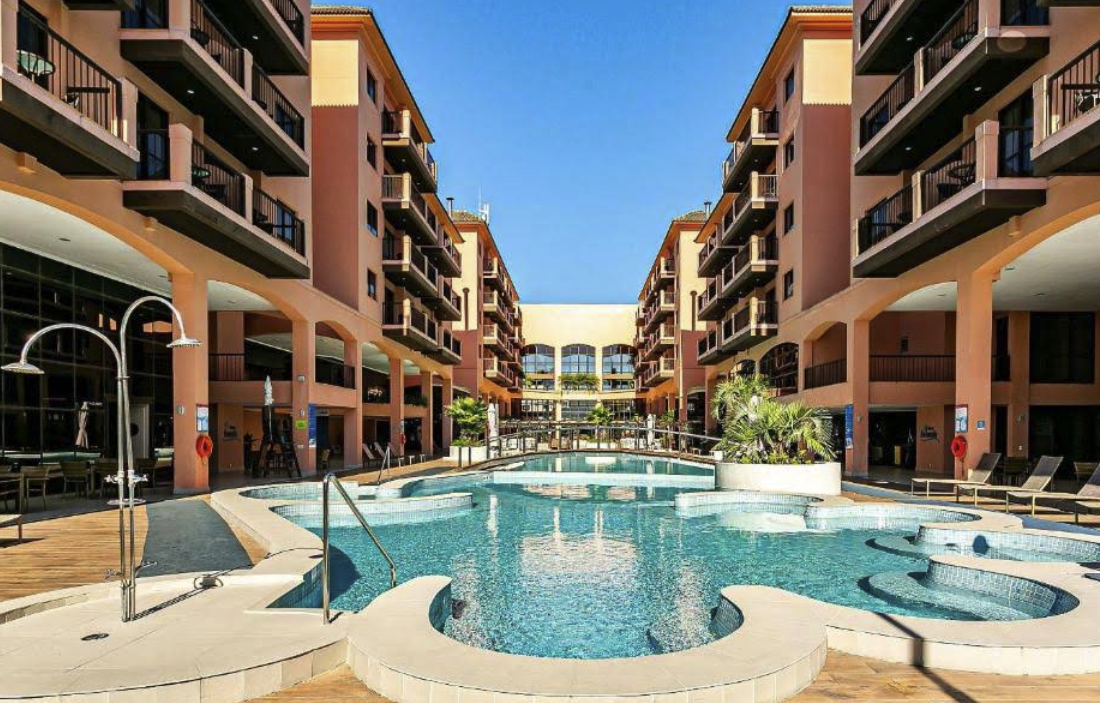
The workshop will take place at Jurere Beach Village
Address: Alameda Cesar Nascimento, 646 - Jurere, Florianopolis - SC, 88053-500, BRAZIL
Accomodation
We have established a partnership with the accommodation hotel that will also host the event. Workshop participants who choose to stay at this hotel will receive special discount coupons. This partnership ensures convenient access to the conference venue and comfortable accommodations for all attendees.
Partner Hotel:
Jurere Beach Village
Website: https://www.jurerebeachvillage.com.br/
Address: Alameda Cesar Nascimento, 646 - Jurere, Florianopolis - SC, 88053-500
Jurere Beach Village is a hotel located in Jurere Internacional, offering beachfront accommodations with complete facilities and services.
Special accommodation discount for LACW 2026 & LATS 2026 participants
Take advantage of the promotional booking link provided by Jurere Beach Village exclusively for workshop attendees.
Organization and institutional support





Supporting Postgraduate Programmes
- Programa de Engenharia e Tecnologia Espaciais, PGETE/INPE
- Programa de Pos-Graduacao em Engenharia Eletrica, PPGEEL/UFSC
- Programa de Pos-Graduacao em Engenharia Eletrica, PPGEE/UFMG
- Programa de Pos-Graduacao em Computacao Aplicada, PPGC/Univali
- Programa de Pos-Graduacao em Engenharia de Teleinformatica, PPGETI/UFC
- Programa de Pos-Graduacao em Engenharia Eletrica, PPEE/UFJF